


Walk into any modern supermarket, and you will find entire aisles lined with identical, crystal-clear golden bottles of honey. They look pristine, pour with watery ease, and never seem to harden on the shelf. Yet, flip that bottle over or examine it closely, and a stark truth emerges: most commercial honey available today has been stripped of the very properties that made honey revered in traditional medicine for thousands of years.
At the other end of the spectrum sits raw honey—cloudy, rich, aromatic, and sometimes semi-solid. To understand why switching to real honey matters for your metabolic health and daily wellness, you must first understand what industrial processing actually removes from the jar.
The Problem with Ultra-Processed Commercial Honey
Commercial liquid honey is engineered for shelf stability and visual appeal, not nutrition. To achieve this, large-scale manufacturers subject natural nectar to two damaging industrial interventions:
High-Heat Pasteurization
Honey is flash-heated up to 70°C or higher. While this prevents yeast fermentation and melts natural sugar crystals to keep the liquid transparent indefinitely, it also destroys heat-sensitive enzymes like glucose oxidase (which produces honey’s natural antibacterial hydrogen peroxide), invertase, and diastase.
Micro-Filtration
Commercial honey is forced through ultra-fine filters under intense pressure. This removes bee pollen, propolis, and fine beeswax fragments. Pollen is honey’s natural fingerprint—it tells you which flowers the bees visited and where the honey came from. Stripping pollen prevents crystallization, but it also strips honey of its allergy-fighting flavonoids, amino acids, and trace minerals.
Furthermore, several investigative tests across the honey industry in India and abroad have revealed that commercial syrups are routinely adulterated with cheap inverted sugar syrups, rice syrups, and high-fructose corn syrups that bypass standard basic lab tests. When you consume ultra-processed commercial honey, you are often consuming liquid sugar without any therapeutic payoff.
What Makes Pure Raw Honey Different?
Raw honey is honey exactly as the bees sealed it inside the honeycomb. It is harvested, strained through a coarse cloth or mesh to remove large hive debris, and bottled directly into glass jars without high heat, chemical clarifiers, or artificial preservatives.
Because it skips industrial thermal processing, raw honey preserves its full botanical profile:
- Bioactive Bee Pollen: A rich source of plant proteins, polyphenols, and micronutrients that support seasonal allergy resilience and digestive enzymes.
- Propolis (Bee Glue): A natural resin collected by bees from tree buds, known for potent antiviral, antifungal, and anti-inflammatory properties.
- Live Enzymes and Antioxidants: Raw honey contains pinocembrin, chrysin, and organic acids that fight oxidative stress and support cellular health.
- Lower Glycemic Load: While all honey contains fructose and glucose, unprocessed raw honey retains organic acids and trace compounds that slow gastric absorption compared to refined commercial syrups.
The Myth of Crystallization
One of the most persistent misconceptions among modern shoppers is that crystallized honey has "gone bad" or contains added table sugar. In reality, the exact opposite is true.
Natural honey is a supersaturated solution of two primary sugars: glucose and fructose. Glucose naturally precipitates out of the liquid state over time, forming soft, buttery crystals around microscopic pollen particles. Raw, unfiltered honey will almost always crystallize, particularly during cooler months or when kept in a cool pantry. Industrial honey does not crystallize easily simply because it has been stripped of pollen nucleation points and heated to unnatural extremes. If your honey thickens and becomes opaque, it is providing physical proof of purity.
Practical Ways to Spot Real Honey at Home
While certified laboratory testing (such as Nuclear Magnetic Resonance or NMR testing) is the ultimate benchmark of purity, you can look for key sensory indicators in your own kitchen:
- Appearance: Raw honey is naturally cloudy, variable in color from hive to hive, and prone to micro-crystallization. Commercial honey stays perfectly clear, translucent, and amber indefinitely.
- Aroma: Raw honey carries a rich, botanical scent specific to the blossoms visited by the bees (such as Sidr, Tulsi, or Acacia). Commercial honey smells flat, overly sweet, or faintly like plain sugar syrup with no floral depth.
- Texture and Flow: Raw honey is thick and dense. It pours in heavy, folding ribbons and stretches rather than splashes. Commercial honey is runny, watery, and drips rapidly like corn syrup.
- Behavior in Water: Drop a spoonful of raw honey into a glass of plain room-temperature water. Real raw honey will stay together and sink straight to the bottom in a dense lump until vigorously stirred. Processed syrup-based honey will begin dissolving and dispersing into the water almost instantly on contact.
How to Choose the Right Jar
When shopping for honey in India, avoid bottles labeled simply as "Honey" or "Pure Honey," as these terms have minimal regulatory enforcement regarding heating. Instead, look for explicit "Raw and Unheated" or "Single-Origin Unfiltered" labels.
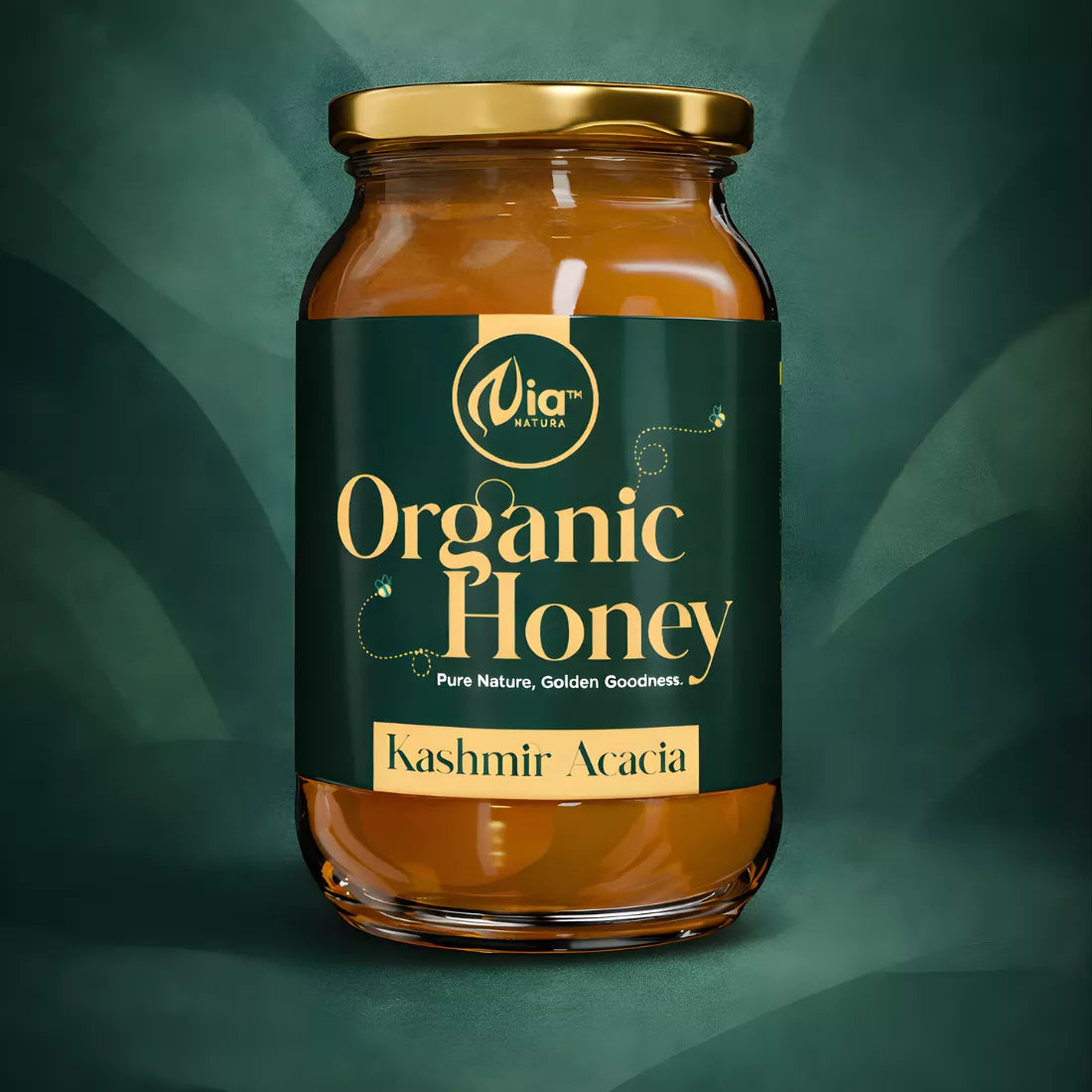
Always opt for glass jar packaging rather than squeezable plastic bottles, as raw honey maintains its enzyme stability better in non-reactive glass. Furthermore, look for specific floral origins such as Kashmir White Honey, Wild Forest, or Sidr which indicate deliberate apiary sourcing rather than aggregated bulk blending.
By swapping mass-market liquid syrups for authentic, farm-sourced raw honey, you transform an everyday sweetener into a functional food packed with living enzymes, antioxidant polyphenols, and genuine medicinal value.
Leave a comment